



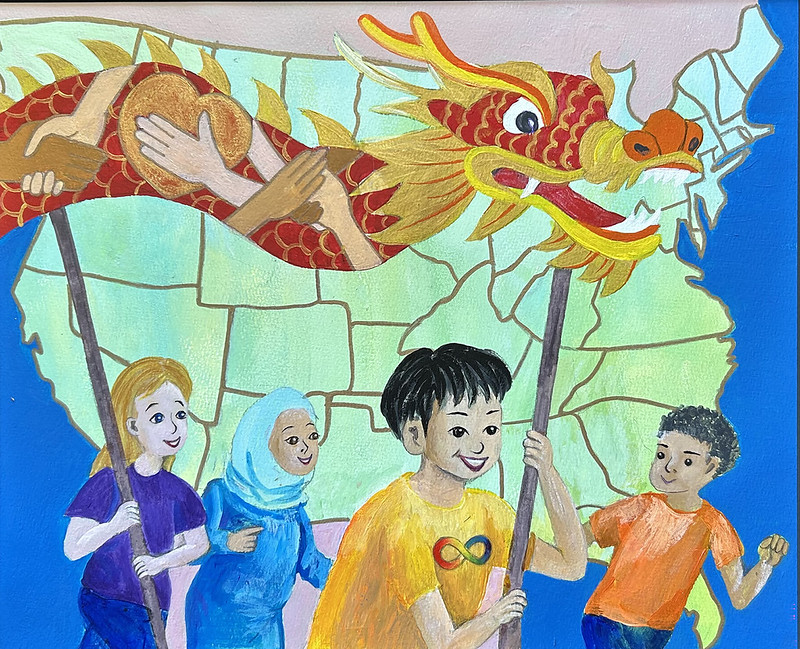
“I Belong in Infinite Love”
Accessible Arts
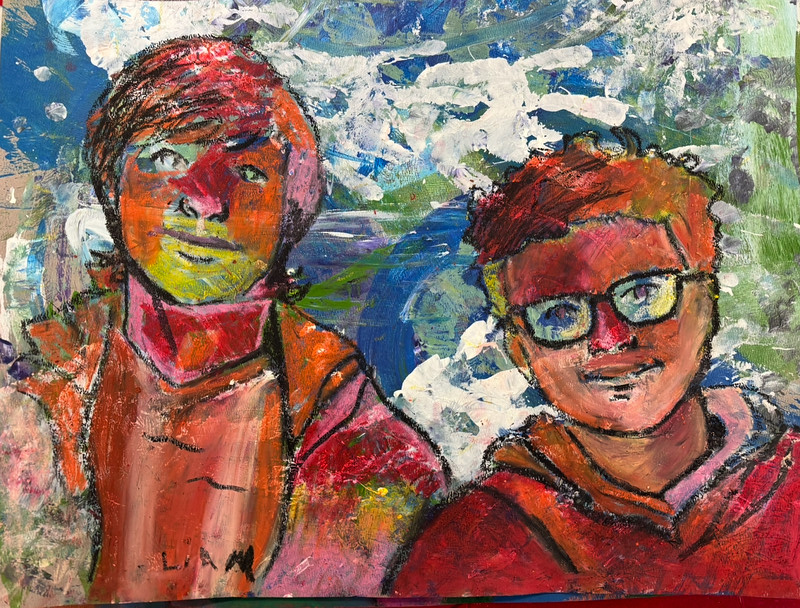
“Friendship Makes Art”
Accessible Arts
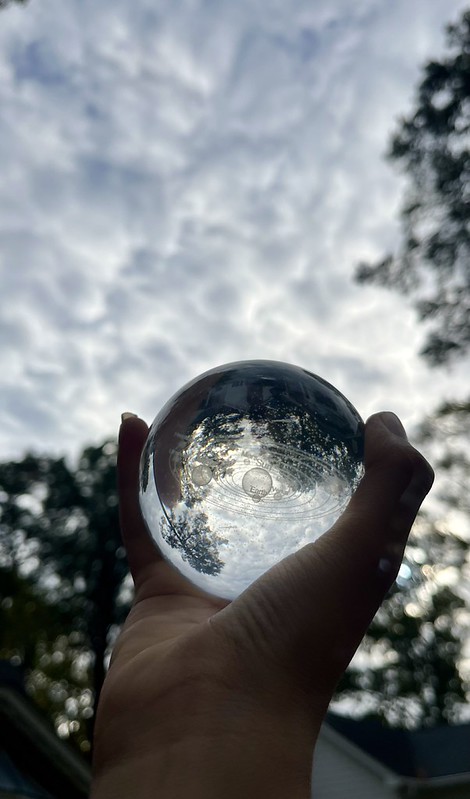
“Holding the World”
Accessible Arts
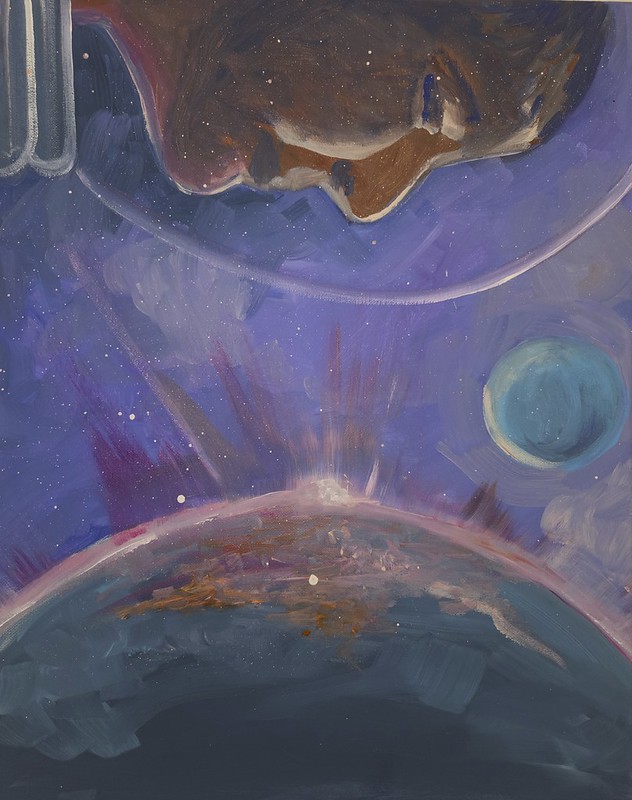
“I Belong To The Universe”
Visual Arts
Creating Your Title & Artist Statement
Rules by Category
ELIGIBILITY. The National PTA Accessible Arts division is an option for students who identify as having a disability and may receive services under IDEA or ADA: Section 504 to have the opportunity and accommodations they may need to participate fully in the program. The division offers modified rules and guidelines to ensure that every student has the chance to be part of the National PTA Reflections® program.
Who qualifies as a disabled individual under the law? The Americans with Disabilities Act (ADA) defines an individual with a disability as a person who: (1) Has a physical or mental impairment that substantially limits one or more of the major life activities of that person; (2) Has a record of such an impairment; or (3) Is regarded as having such impairment.
HOW TO ENTER. Students who identify as having a disability have two ways to enter the National PTA Reflections® Program. All students may enter in only one division. The student entry form requires parent/legal guardian signatures.
- Option 1. Enter in Grade-Level Divisions: Regardless of age, students with disabilities may enter in the grade division most closely aligned to their support needs. Students are recognized and awarded prizes as part of the grade division in which they compete. The divisions are as follows: Primary (pre-K – grade 2); Intermediate (grades 3-5); Middle School (grades 6-8); High School (grades 9-12). Students may not receive assistance apart from that which is allowed in the grade division.
- Option 2. Enter in Accessible Arts Division: Eligible students entering the division create their own artwork but may receive non-artistic accommodation and assistance from an adult. Students are recognized and awarded prizes as part of the Accessible Arts division.
DIVISION GUIDELINES. Student artists should follow the general rules and arts category guidelines specific to their submissions, modified only by accommodations for individuals with disabilities. The accommodation, in general, should be both specific and limited to the student’s disability.
Allowable Accommodations: Given the diverse range of physical and mental disabilities that exist, it would be impossible to outline specific accommodations for each and every disability, but the following provides a non-exhaustive list of allowable accommodations:
- The division will not be divided by age or traditional school grade level.
- Use of adaptive technology is allowed.
- All submissions must be solely created by the student artist. However, a parent, teacher, or other adult may assist the artist with typing, holding a camera, etc.
Accommodations that are Not Allowed: Individuals providing assistance to student artists may not, in any way, involve themselves in the actual artistic process by:
- Personally selecting a title for artwork.
- Writing, editing, or interpreting a student’s artist statement, story, poetry, or script.
- Choreographing a dance, composing music, or writing lyrics.
- Drawing, painting, or personally creating a visual arts submission, choosing a camera angle, etc.
All participants must also follow the official rules for Participation.
PHOTOGRAPHY is the process of creating an image. The photographer (student submitting entry) is a person who captures their own thoughts and ideas with a camera. By focusing on objects using various lenses, filters and light sources, photographers may demonstrate the use of photographic techniques conventionally or digitally.
- Accepted forms of photography include: A single photo, panoramic, photomontage (one print of multiple original photos), a multiple exposure, negative sandwich, or photogram. Original black-and- white and color images are accepted.
- Non-accepted forms of photography include: Entries with added graphics over the image, including lettering, are not accepted. Collages and collections of photos are not accepted. Original film (negatives or transparencies) and multidimensional pieces are not accepted.
Consider the use of objects, lighting, and the location to show a clear relation of the photo to the theme. An explanation of the photography process/form might be a useful addition to the artist statement. Whether an entry displays use of technologies or a simple approach, it will be judged primarily on how well the student uses his or her artistic vision to portray the theme, originality and creativity.
Digital technology and/or software can be used to develop, enhance and/or present an entry but may not provide the primary design and/or concept. Entrants must provide a brief description of the tools and methods used in the creation process, including any generative elements.
Copyright. Plagiarized entries will be disqualified. Use of copyrighted material, including any copyrighted cartoon characters, material downloaded from the internet, copyrighted or copyrighted photographs, or stock images, is not acceptable, except for the following:
- Entries may include public places, well-known products, trademarks, or certain other copyrighted material as long as that copyrighted material is incidental to the subject matter of the piece and/or is a smaller element of a whole. The resulting work cannot try to establish an association between the student and the trademark /business/material, or influence the purchase/non-purchase of the trademarked good.
All participants must also follow the official rules for participation.
VISUAL ARTS include many art forms that are visual in nature. The artist (student submitting entry) is a person who captures their own thoughts and ideas to create a visual piece of art.
- Accepted forms of visual art include: Architecture (2D/3D), carpentry, ceramics, collages, photographic collages (multiple photos cut/pasted), digital art and graphics (drawings/paintings/illustration), crafts, design, dioramas, drawing, fiberwork, jewelry, kites, metal etching/punch work, mobiles, painting, printmaking, sculpture, and wind chimes. Reproductions or enlargements of other artwork are not accepted.
An explanation of the art form might be a useful addition to the artist statement. Whether an entry displays use of formal technique or a simple approach, it will be judged primarily on how well the student uses his or her artistic vision to portray the theme, originality, and creativity.
Digital technology and/or software can be used to develop, enhance and/or present an entry but may not provide the primary design and/or concept. Entrants must provide a brief description of the tools and methods used in the creation process, including any generative elements.
Copyright. Plagiarized entries will be disqualified. Use of copyrighted material, including any copyrighted cartoon characters, material downloaded from the internet, or copyrighted photographs or stock images, is not acceptable, except for the following:
- Entries may include portions of existing copyrighted works, such as photographs, magazine or digital media clippings, and/or type cut out of a newspaper, as long as those portions of copyrighted works are used to create a completely new and different work of art.
- Entries may include public places, well-known products, trademarks, or certain other copyrighted material as long as that copyrighted material is incidental to the subject matter of the piece and/or is a smaller element of a whole. The resulting work cannot try to establish an association between the student and the trademark /business/material, or influence the purchase/non-purchase of the trademarked good.
All participants must also follow the official rules for participation.
DANCE CHOREOGRAPHY is the act of creating movement. The choreographer (student submitting entry) maybe the performer or one of the performers, but the choreographer does not have to perform in the entry.
Consider the following styles and ensembles to portray your original choreography: Ballet, Contemporary, Hip Hop, Jazz, Tap, Folk Dance, Religious Dance, Dance Ensembles (color guard/indoor guard), Ice Skating/Dancing and Gymnastics-floor Routine.
Consider using background song(s), props, and the location to show a clear relation of the dance choreography to the theme. An explanation of the origin of the dance and/or the significance of the choreography might be a useful addition to the artist statement when submitting a dance choreography entry that involves traditional, cultural, or regional dances. Whether an entry displays formal dance technique or a simple approach, it will be judged primarily on how well the student uses his or her artistic vision to portray the theme, originality, and creativity.
Copyright: Use of copyrighted material is prohibited. Plagiarized entries will be disqualified. If background music is used in dance choreography entries, it must be cited on the entry form (title, composer, and performer).
Suggestions for Audio/Visual Quality:
- Use a tripod to hold the camera still.
- Make sure there is plenty of lighting, especially if shooting indoors.
- Turn off all noise-making devices in the room (air conditioners, fans, telephones, etc.).
- Record a short test and listen to it. If needed, change the record volume or microphone location.
- Make sure the background music (if any) is audible on the recording.
- Allow for two seconds of silence at the beginning and end of your recording.
Submission Requirements:
- Only new pieces of artwork inspired by the theme may be submitted.
- Each entry must be the original work of one student only.
- Cite background music (if any) on the student entry form.
- Video must not exceed 5 minutes in length and 1,000 MB (1,000 megabyte) in file size.
- Accepted file formats include: .mp4, .mov, .avi file format.
All participants must also follow the official rules for participation.
FILM PRODUCTION is the process of making a film. The producer (student submitting the entry) is not required to appear in the film but if the student chooses to, a camera tripod may be used. All screenwriting, directing, and editing must be done by the student producer. All entries must be original student footage.
Consider the following styles to portray your original work of fiction or nonfiction:
- Animation: Demonstrates motion by sequencing still objects or using computer-generated graphics.
- Narrative: Tells a fictional story developed by the student.
- Documentary: Presents facts and information.
- Experimental: Explores movement, light and montage.
- Multimedia: Uses a combination of different contents (text, audio, still images, animation, etc.).
An explanation of the storyline and/or the significance of the film style might be a useful addition to the artist statement. Whether an entry displays use of technologies or a simple approach, it will be judged primarily on how well the student uses his or her artistic vision to portray the theme, originality, and creativity.
Digital technology and/or software can be used to develop, enhance and/or present an entry but may not provide the primary design and/or concept. Entrants must provide a brief description of the tools and method used in the creation process, including any generative elements. PowerPoint presentations are prohibited.
Copyright. Plagiarized entries will be disqualified. Use of copyrighted material, including any copyrighted cartoon characters, material downloaded from the internet, copyrighted recorded music, or copyrighted photographs or stock images, is not acceptable, except for the following:
- If background music is used in film production entries, it must be cited on the entry form (title, composer, and performer).
- Entries may include public places, well-known products, trademarks, or certain other copyrighted material as long as that copyrighted material is incidental to the subject matter of the piece and/or is a smaller element of a whole. The resulting work cannot try to establish an association between the student and the trademark/business/material, or influence the purchase/non-purchase of the trademarked good.
- Entries may include portions of existing copyrighted works, such as photographs, magazine or digital media clippings, and/or type cut out of a newspaper, as long as those portions of copyrighted works are used to create a completely new and different work of art.
Suggestions for Audio/Visual Quality:
- Use a tripod to hold the camera still
- Make sure there is plenty of lighting, especially if shooting indoors
- Turn off all noise-making devices in the room (air conditioners, fans, telephones, etc.)
- Record a short test and listen to it. If needed, change the record volume or microphone location.
- Make sure the background music (if any) is audible on the recording.
- Allow for two seconds of silence at the beginning and end of your recording.
Submission Requirements
- Only new pieces of artwork inspired by the theme may be submitted.
- Each entry must be the original work of one student only.
- Use of background music must be cited on the student entry form.
- Video must not exceed 5 minutes in length and 1,000 MB(1,000 megabyte) in file size.
- Accepted file formats include: .mp4, .mov, .avi.
All participants must also follow the official rules for participation.
LITERATURE is the art of writing. The author (student submitting entry) is a person who expresses their own thoughts and ideas through the use of words. Authors submit a single literary work, handwritten or typed, using grade-appropriate grammar, punctuation, and spelling.
Consider the following literary styles to portray your original work of fiction or nonfiction: Prose, Poetry, Drama, Reflective essay, Narrative, Short story. Collections of literary work (such as poems and short stories) are not accepted.
An explanation of the storyline and/or the significance of the literature style might be a useful addition to the artist statement. Whether an entry displays formal writing technique or a simple approach, it will be judged primarily on how well the student uses his or her artistic vision to portray the theme, originality, and creativity.
Copyright: Use of copyrighted material is prohibited. Plagiarized entries will be disqualified.
The following uses of dictation, transcription, illustration, and translation are acceptable:
- Entries may be typed by another person as long as the original work or a copy of the original work is attached.
- If the student artist is unable, entries may be dictated to another person and printed or typed in exact words as provided by the student.
- Students for whom English is not their first language may submit entries in their own language. An interpretive translation in English must accompany the entry.
- Translators/Transcribers should make every attempt to retain the same level of language and accuracy that is reflected in the student’s original work.
- Illustrated entries, including books, with pictures drawn by the student author are acceptable; however, only literary content is judged.
Submission Requirements:
- Entry must not exceed 2,000 words. Accepted file types include PDF.
- Only new pieces of artwork inspired by the theme may be submitted.
- Each entry must be the original work of one student only.
All participants must also follow the official rules for participation.
MUSIC COMPOSITION is the process of creating a new piece of music. The composer (student submitting entry) is a person who expresses their own thoughts and ideas through the use of sound. The student composer may submit an entry performed by an individual or group and/or make use of a sound library generated performance of a composed score. Student composers are not required to perform their composition, but a recording of the composition must be included.
Consider the following musical styles and instruments to portray your original composition: A Cappella, Blues, Choral, Country, Electronic, Hip hop, Jazz, Latin, Musical, Orchestral, Pop, R&B, Religious, Rock, Symphonic/Concert Band, and Traditional.
An explanation of the origin of the music and/or the significance of the music style might be a useful addition to the artist statement when submitting a music composition that involves traditional, cultural, or regional instruments. Whether an entry displays formal composition technique or a simple approach, it will be judged primarily on how well the student uses his or her artistic vision to portray the theme, originality, and creativity.
All instruments, sounds, styles, and combinations are accepted. Software may be used to produce an audio recording. Entries containing algorithmic composition techniques are not accepted. Digital technology and/or software can be used to develop, enhance, and/or present an entry but may not provide the primary design and/or concept. Entrants must provide a brief description of the tools and method, including any generative elements.
Music Score/Notation (For Middle and High School grade divisions only):
- Middle and high school grade divisions must include music score/notation, either traditional or tablature, or a written reflective statement that provides a musically technical explanation of how the music was created (100 words or less).
- Notation software may be used to create a score. Whether the score is handwritten or software-generated, appropriate instrumentation and voicing are required for the performance.
Copyright: Use of copyrighted material is prohibited. Plagiarized entries will be disqualified.
Suggestions for Audio Quality:
- Do not place the recording device on top of an instrument(s) or speakers.
- Turn off all noise-making devices in the room (air conditioners, fans, telephones, etc.).
- Record a short test and listen to it. If needed, change the record volume or microphone location.
- Make sure the music is audible on the recording.
- Allow for two seconds of silence at the beginning and end of your recording.
Submission Requirements:
- Only new pieces of artwork inspired by the theme may be submitted.
- Each entry must be the original work of one student only.
- Notation is required for the middle and high school divisions. Accepted file types include PDF.
- Audio recording must not exceed 5 minutes in length and 1,000 MB (1,000 megabytes) in file size.
- Accepted audio file formats include: MP3 and WAV.
All participants must also follow the official rules for participation.
Download the Rules by Categories
- Accessible Arts Division (English | en español)
- Dance Choreography (English | en español)
- Film Production (English | en español)
- Literature (English | en español)
- Music Composition (English | en español)
- Photography (English | en español)
- Visual Arts (English | en español)
For extra details about general submissions, visit the California PTA website.